

The Data Literacy Gap: Why Your Organization Can’t Just “Do” Data Governance
Moving beyond the buzzwords to build a true Data Supply Chain.

At DAI Consultancy, we often walk into boardrooms where the desire for “better data” is palpable. Executives are eager to monetize their information assets, launch Artificial Intelligence initiatives, or simply stop the bleeding caused by operational inefficiencies. They sign off on expensive software, hire data scientists, and announce that the organization is now “data-driven.”
Yet, a year later, the results are often underwhelming. The data lakes turn into swamps, the AI models are trained on unreliable inputs, and the “single source of truth” remains a myth.
Why does this happen? In our experience enabling organizations to convert governed data into reliable intelligence, the failure point is rarely the technology. It is a lack of Data Literacy among leadership.
We aren’t talking about knowing how to write SQL queries or understanding Python code. We are talking about a fundamental misunderstanding of the concepts that underpin successful data management. Far too often, we hear executives say, “Data stuff? Oh, send that to the governance team to fix.”
To build a sustainable data capability, especially in a rapidly evolving market like Qatar, organizations must move beyond slogans and embrace five foundational realities.
1. “Data as an Asset” is More Than a Metaphor
Every corporate strategy document today includes the phrase “Data is an Asset.” It is the most common information principle published within organizations. But for governance to actually work, this cannot just be a motivational poster on the wall. It requires an accounting mindset.
In the financial world, assets are rigorously managed, secured, and accounted for. They have value, but they also carry liability. If you own a fleet of trucks (an asset), you must maintain them. If you neglect them, they break down, cause accidents, and become a liability.
Data is no different. The “value” of data only appears when it is used effectively to make a decision. Conversely, the negative value (liability) accrues when data is used incorrectly, breaches privacy regulations, or leads to flawed strategic decisions.
At DAI Consultancy, we advise clients to look at the “liability side” of their data balance sheet. If your governance program is just about “cleaning up” messy data tactically, you are playing a game of “Data Whack-a-Mole.” True asset management means establishing a systemic approach where the cost of maintenance is justified by the reduction of risk and the increase in decision-making power.
2. The Governance “V”: Separating Church and State
One of the most critical concepts for technical professionals and executives to grasp is the separation of duties. We often see IT departments trying to police themselves, which inevitably leads to conflict and compromised standards.
To visualize the correct structure, we use the Governance “V” model.
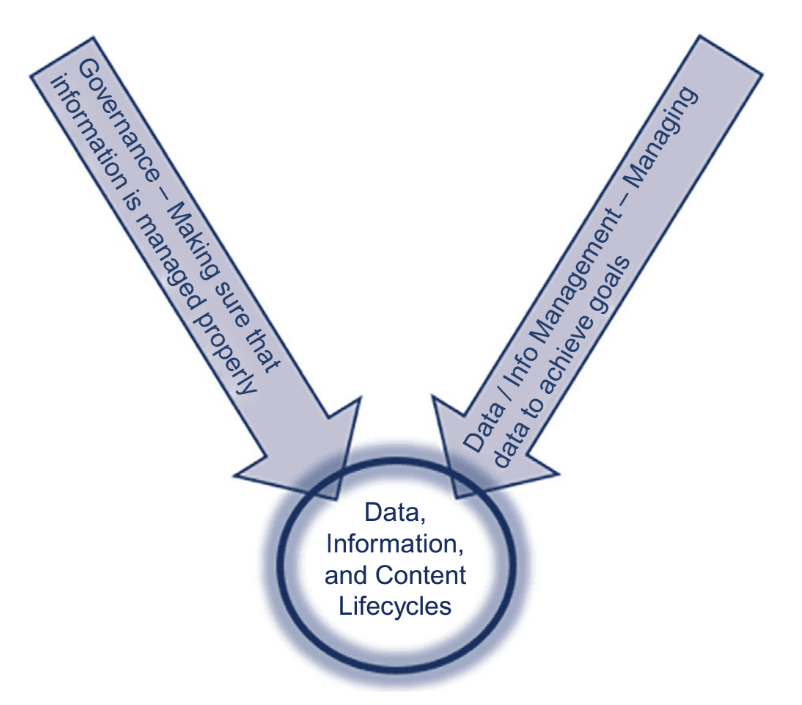
The Governance “V” Model: Separating oversight (Governance) from execution (Management)
Source: Data Governance: How to Design, Deploy, and Sustain an Effective Data Governance Program by John Ladley
The Left Side (Governance): This is the oversight function. It involves defining the rules, policies, and standards. It is about ensuring that data is managed properly.
The Right Side (Management): This is the execution function. It involves the actual engineering, lifecycle management, and usage of data to achieve goals. It is about doing the data management.
At the bottom of the V, where the lines meet, is the actual data lifecycle: creation, use, and disposal.
Think of it like a financial audit. In business, you have managers who execute trades and spend money, and you have auditors who verify compliance with standards. You would never ask the person spending the money to audit themselves. Yet, organizations frequently ask their Database Administrators or Data Engineers to “do governance” while they are simultaneously trying to ship code.
Governance defines the “what” (the rules). Management executes the “how” (the implementation). When we help clients implement this separation of duties, we see an immediate improvement in accountability and data quality.
3. The Data Supply Chain
Another concept that transforms how organizations view governance is the Data Supply Chain.
If you manufacture a product, you have a logistics chain: raw materials are acquired, assembled, shipped, distributed, and consumed. This process is engineered to perfection. You wouldn’t accept a supply chain where 20% of the parts are defective or go missing.
Data moves through a parallel supply chain. It is created (e.g., a customer fills out a form), processed (stored in a database), aggregated (moved to a warehouse), and consumed (used in a report or AI model).
Governance is simply the quality assurance (QA) and logistics management of this supply chain. It ensures that the “raw material” (data) entering your AI models is pure. If you are building a Master Data Management (MDM) solution or a Business Intelligence dashboard, you are essentially building a factory. Governance ensures that the factory produces a reliable product, not digital scrap.
4. Governance is a Capability, Not a Department
A common barrier to success is the belief that Data Governance is a new department that sits in the basement and says “no” to everyone.
At DAI Consultancy, we reframe this: Data Governance is a Business Capability.
A capability is a “WHAT.” It describes what an organization needs to do to fulfill its mission. Just as “Sales” or “Customer Service” are capabilities required to generate revenue, Governance is a capability required to generate intelligence.
When you view governance as a capability, you stop treating it like a temporary project with a start and end date. It becomes a permanent operational state. It links directly to your business strategy. For example, if your strategy is “Personalized Customer Experiences,” you need the capability of “High-Quality Customer Data,” which in turn requires the capability of “Data Governance” to standardize that data.
This capability-based approach allows you to break through departmental silos. It shifts the focus from “Who owns this server?” to “What do we need to do to execute our strategy?”
5. Evolution, Not Revolution
Finally, we must address the pace of change. Because the concepts we have discussed (liability, separation of duties, supply chains) require a shift in mindset, they cannot be forced overnight.
We often see “Big Bang” implementations fail. An organization tries to govern everything at once, creating a bureaucratic bottleneck that frustrates everyone.
Successful governance is an evolution, not a revolution. Organizations typically go through four stages of learning:
1. Rote: You can recite the definitions of data quality, but you don’t really “get” it. 2. Understanding: Leadership comprehends the importance, but hasn’t acted. 3. Application: You start applying governance to specific pain points (e.g., fixing a specific report). 4. Correlation: You can apply the concepts creatively to complex situations, like retrofitting governance into an ERP migration.
We help our clients navigate this maturity curve. We start by establishing GAIP (Generally Accepted Information Principles), a concept modeled after GAAP in accounting, to set the philosophical groundwork. Once the principles are in place, we build the policies and standards that enforce them.
Conclusion: The DAI Approach
The difference between a failed data initiative and a sustainable intelligence engine is often just literacy. It is the ability of leadership to look at a dashboard and understand not just the numbers, but the supply chain that produced them and the governance that secured them.
At DAI Consultancy, we specialize in bridging this gap. We don’t just deliver technical solutions; we help you build the internal capabilities, the “Governance V,” and the strategic mindset required to treat data as a true business asset.
Whether you are looking to secure your master data, deploy ethical AI, or simply trust your own reports, the journey begins with understanding the concepts that matter.
Keep reading
More insights

Why Your Data Strategy Stalls: Governance is a Business Capability, Not a Project
Why do ambitious data programs stall after a strong start? The answer rarely lies in technology, it lies in treating governance as a project rather than a core business capability.
Feb 14, 2026 · 3 min read
What Does Data Governance Actually Look Like? A Blueprint for the Modern Enterprise
From heat maps to human behavior, a practical blueprint for designing a data governance program that works beyond the boardroom and into daily enterprise operations.
Feb 5, 2026 · 8 min readReady to build your data strategy?
Let's discuss how governance-first thinking can transform your organization's approach to data and AI.
Get in touch