

What Does Data Governance Actually Look Like? A Blueprint for the Modern Enterprise
From Heat Maps to Human Behavior: Designing a Program That Lasts

At DAI Consultancy, we hear one question from executives more than any other. It usually comes after the initial pitch, after we have explained that data is an asset and that governance is a capability. The executive leans forward and asks:
“Okay, I get the theory. But what does it actually look like on a Tuesday morning?”
It is a fair question. For many, Data Governance (DG) feels like an abstract cloud of policies and rules. They imagine a new department, a room full of auditors, or a piece of expensive software.
But in reality, a mature Data Governance program looks remarkably boring. In fact, the ultimate goal of DG is to disappear.
Think about your organization’s financial controls. You do not have a daily “Financial Governance Meeting” to decide if you should record revenue correctly. You just do it. It is baked into the fabric of your business. That is the end state we build toward. It is a world where “doing data right” is just business as usual.
However, getting to that state requires a deliberate design. Based on our experience helping enterprises in Qatar and the region build sustainable data capabilities, here is the blueprint for what a functioning DG program looks like. We will cover everything from the scope of authority to the human behavior on the ground.
1. The Scope: It Is Not All or Nothing
A common mistake we see is the “Big Bang” approach. This is where an organization attempts to govern every piece of data, everywhere, all at once. This inevitably leads to burnout and failure.
Successful governance is Federated. Just as a federal government handles defense while local municipalities handle trash collection, your data governance must be tiered.
To visualize this, we use the Federation Heat Map concept. Imagine your organization as a series of zones:
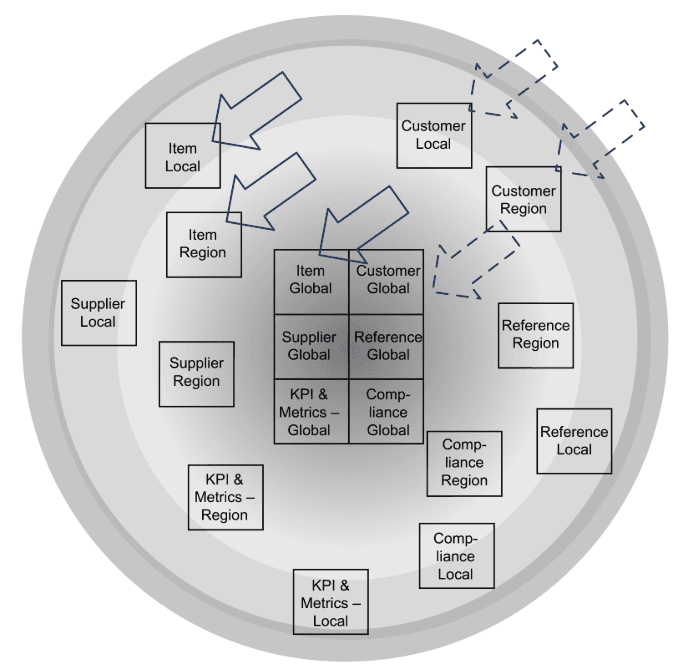
The Federation Heat Map: Data governance tiers from centralized Global control to distributed Local autonomy
Source: Data Governance: How to Design, Deploy, and Sustain an Effective Data Governance Program by John Ladley
Understanding the Three Layers
1. The Global Layer (The Center or “Hot Zone”)
- What it is: This is the core of the heat map. It represents data that is shared across the entire enterprise.
- Governance Intensity: This is the “Hot Zone” where governance is tightest. Standards here must be followed by everyone to ensure a “single source of truth”.
- Example: A “Global Item” list ensures that Product ID #123 refers to the exact same widget in Qatar, London, and New York.
2. The Regional Layer (The Middle)
- What it is: This layer surrounds the center. It represents data that is specific to a large division, brand, or geographic area.
- Governance Intensity: Control is slightly looser here. The region must follow Global standards where they exist, but they have the autonomy to create their own standards for data that only matters to them.
- Example: “Customer Region” data might include specific marketing classifications that apply only to the Middle East market but are irrelevant to the European market.
3. The Local Layer (The Fringe or “Cool Zone”)
- What it is: This is the outer ring of the map. It represents data used by a single department, office, or small team.
- Governance Intensity: This is the “Cool Zone” where governance is barely applied. The strict rules of the center do not apply here because the risk is low.
- Example: “Item Local” might refer to a spreadsheet used by a local warehouse manager to track temporary supplies. It does not need to go through a global approval committee.
In summary, the two zones to keep in mind are:
- The Hot Zone (Global/Central): This includes critical data like “Customer Master” or “Financial KPIs.” This data requires tight, centralized control. Everyone must use the exact same definition of “Net Profit” or “Active Customer”.
- The Cool Zone (Local/Regional): This might include a local warehouse’s inventory list or a regional marketing campaign’s temporary data. Here, governance is loose. A local manager can make decisions without calling headquarters.
Executive Action: Do not try to boil the ocean. Define your “Hot Zone.” If you are a conglomerate with multiple distinct business units, you may need three separate DG programs that only share a few core standards. If you are a highly integrated global retailer, your scope will be much wider.
2. The Four Pillars: Adding “Data” to the Mix
Every consultant will tell you that a program needs People, Process, and Technology. But in Data Governance, there is a fourth, non-negotiable pillar which is Data.
Here is what these four elements look like in a real-world implementation:
A. Process: Capabilities Instead of Org Charts
When we design the “Process” side of governance, we do not start with an org chart. We start with Capabilities. An org chart implies a permanent department. This often triggers political turf wars. A Capability is simply a statement of what needs to be done.
- Example: Instead of creating a “Data Quality Department,” we establish a “Data Quality Capability.” This capability might be executed by a person in IT, a business analyst in Finance, and a steward in Marketing.
- The Matrix: In practice, this looks like a matrix rather than a hierarchy. You have a “Strategic Layer” (executives setting principles), a “Tactical Layer” (managers resolving issues), and an “Operational Layer” (stewards fixing data).
B. People: The Rise of the Top Data Job
Who is accountable? This is the hardest question for many organizations. In a mature program, there is a Top Data Job which is often a Chief Data Officer (CDO). This person does not report to the CIO. This is a crucial distinction, as IT should not grade its own homework. The CDO holds the ultimate accountability for data as an asset. Below the CDO, we assign Data Owners or Stewards. These are not necessarily new hires. They are existing employees who are given a new hat to wear. The Marketing Director becomes the “Customer Data Owner” and the Controller becomes the “Financial Data Owner.”
C. Data: The Landscape
You cannot govern what you do not know. A key part of the program is building the Data Landscape. This is an inventory of what you have, where it is, and where it came from (lineage).
- Scenario: If you are migrating to a new ERP system (like SAP or Oracle), your “Data” pillar focuses heavily on understanding the legacy data before it is moved. This is often the trigger event that launches a governance program.
D. Technology: The Trap
Warning: This is the most dangerous pillar. We frequently see organizations buy an expensive Data Governance tool. This is usually a glossy software suite that promises to solve everything. They buy it before they have defined a single policy. Do not buy the tool first. A tool exists to automate a process. If you have no process, the tool will just automate your confusion. We have seen millions of riyals wasted on software that sits unused because the organization never agreed on who was allowed to use it. Build the capability first. Then buy the tool to “grease the skids” later.
3. Principles vs. Policies: The Bill of Rights
How do you get thousands of employees to care about data? You cannot write a rule for every possible scenario. Instead, you need Principles.
Think of Principles as your organization’s Bill of Rights. They are high-level beliefs that guide behavior when no one is watching.
- Principle: “Data is a shared asset and not a departmental property.”
- Policy: “The Customer Master file must be accessible to the Sales team.”
- Rule: “Field 4 in the Customer Table must be 10 characters long.”
Principles are rock while rules are sand. Principles reduce the number of meetings you need because they provide a clear compass for decision-making. If a department manager refuses to share data, you do not argue about the rule. You point to the Principle. “We agreed that data is a shared asset.”
4. The Human Element: The Story of Gladys
Finally, let us talk about the most critical success factor. This is Change Management. At DAI Consultancy, we often tell the story of “Gladys” to illustrate why programs fail.
- The Scenario: Gladys works in your procurement department. For 20 years, she has logged into four different legacy systems to do her job. She manually downloads data into a spreadsheet. She fixes the errors she knows about by heart. Then she emails a report to her boss. She is the human integration point.
- The Mistake: You launch a new Data Governance program and a shiny new ERP. You send Gladys an email on Friday saying, “Here is your new password. The new system goes live Monday.”
- The Result: Gladys fails. The data quality tanks. Why? Because you treated this as a technology upgrade rather than a human behavior change.
Gladys did not just need a password. She needed to be part of the process. She needed to understand why her manual fixes were no longer sufficient. She needed training, empathy, and a transition plan.
Data Governance is 10% technology and 90% psychology. If you do not manage the change for the “Gladyses” of your organization, your program will be nothing more than a well-written document on a shelf.
Checklist: Is Your Program Real?
To determine if your Data Governance program is on the right track, ask these five questions:
- Is it Business-Led? Does the program report to the business (CEO/COO) rather than just IT?
- Is the Scope Clear? Have you defined your “Hot Zones” vs. “Cool Zones,” or are you trying to govern everything equally?
- Are the Principles Published? Does every employee know that data is an asset, or is that just a secret held by the data team?
- Is there a Top Data Job? Is there a single human being accountable for the state of your data assets?
- Are you measuring Value? Are you tracking metrics that matter to the business (e.g., “Reduction in billing errors”) rather than just vanity metrics (e.g., “Number of meetings held”)?
Conclusion: Making It Business as Usual
Data Governance is not a project with a finish line. It is a new way of working.
At DAI Consultancy, we help organizations navigate this complexity. We do not just install tools. We help you design the Federation, draft the Principles, and support the “Gladyses” who make it all work.
The goal is not to have a loud, flashy Data Governance program. The goal is to reach a point where you do not even talk about “governance” anymore. This is because managing data as a valuable asset is just the way you do business.
Keep reading
More insights

Why Your Data Strategy Stalls: Governance is a Business Capability, Not a Project
Why do ambitious data programs stall after a strong start? The answer rarely lies in technology, it lies in treating governance as a project rather than a core business capability.
Feb 14, 2026 · 3 min read
The Data Literacy Gap: Why Your Organization Can’t Just “Do” Data Governance
Executives want “better data” but struggle to deliver on the promise. The failure point is rarely technology. It is a fundamental gap in data literacy among leadership.
Feb 10, 2026 · 6 min readReady to build your data strategy?
Let's discuss how governance-first thinking can transform your organization's approach to data and AI.
Get in touch